The UK government’s latest procurement reforms could reshape how FM, cleaning and support service contracts are won and managed. Here is what buyers and suppliers should do now.
7 Signs Your Current FM Supplier Is Reactive, Not Structured
Buyers usually do not replace an FM supplier because of one dramatic failure. They replace them because the same frustrations keep repeating: weak supervision, unclear ownership, poor communication, slow follow-up and too little confidence in what is really happening on site. That matters more than ever. Government contract management guidance now puts clear accountability, defined roles, documented plans and effective handover at the centre of good supplier management, while HSE continues to highlight how poor control around cleaning and workplace safety creates real risk. Slips and trips remain the single most common cause of major injury in UK workplaces, and HSE notes that cleaning activity itself can create those hazards if it is not properly managed. A reactive supplier does not always look bad in a proposal. Often, they look fine until the contract is live. Then the gaps start to show. 1. You are always chasing, instead of being updated If your team has to keep asking what is happening, whether issues were fixed, or who is actually dealing with a problem, the supplier is not operating with enough structure. A well-run FM service should not depend on the client constantly prompting action. It should have clear ownership, regular communication, visible escalation and reporting that tells you what has happened, what is being done next and where the risks sit. Public sector contract management guidance is explicit that accountability, roles, governance and documented management plans must be clear. What buyers feel:“We should not have to manage the supplier this closely.” 2. Standards depend too heavily on one person If performance lifts only when a particular supervisor is on site, or drops the moment that person is absent, you do not have a structured service model. You have a fragile one. Structured suppliers build standards into the contract through audits, checks, escalation routes, clear responsibilities and repeatable site disciplines. Reactive suppliers often rely on individuals firefighting problems after they appear. What buyers feel:“This works when the right person is around, but not as a system.” 3. Mobilisation felt rushed, vague or incomplete Most FM problems do not start three months into the contract. They start in mobilisation. If the handover was messy, site information was incomplete, staffing felt uncertain, reporting was not ready, or early promises did not translate into live control, that is a warning sign. Government guidance says mobilisation and transition should be planned properly, with continuity considered early and contract management arrangements clearly defined. What buyers feel:“We never really felt the contract landed properly.” 4. Problems are fixed temporarily, not properly Reactive suppliers tend to treat symptoms instead of causes. A missed clean gets re-done. A complaint gets answered. A guard is swapped. A waste issue gets cleared. But the same issue comes back because nobody has fixed the underlying control problem. Structured suppliers look beyond the single incident. They ask why it happened, what failed around it, what needs tightening and how recurrence will be reduced. What buyers feel:“We keep revisiting the same problems in different forms.” 5. Reporting looks busy, but tells you very little Many FM reports are full of activity and low on meaning. If reporting is mostly attendance logs, generic updates or traffic-light summaries without context, it may create the impression of control without actually giving you confidence. Buyers need reporting that helps them understand performance, trends, unresolved issues, corrective action and whether standards are being sustained. That matters particularly where safety, hygiene, security, waste control and compliance are involved. HSE’s guidance on violence, aggression, slips and trips all points back to the need for risk assessment, reporting, review and stronger controls, not just reactive response. What buyers feel:“We are receiving updates, but not real visibility.” 6. Security, cleaning and support services feel disconnected Where security says one thing, cleaning says another, and operational support sits somewhere in between, buyers lose confidence quickly. This is one of the clearest signs of a reactive supplier model. Services may exist, but they are not being managed as one joined-up operating picture. That creates friction, duplicated effort, slower escalation and more blind spots. A more structured FM partner brings cleaning, security, waste, front of house, pest control, mobilisation and specialist support into a clearer management approach, so the client sees one controlled service story rather than multiple moving parts. What buyers feel:“We are buying several services, but it does not feel coordinated.” 7. You cannot easily evidence what the supplier has actually controlled The final warning sign is often the most serious one. When a buyer cannot clearly evidence what has been checked, corrected, escalated, trained, sanitised, secured, disposed of or improved, confidence starts to fall. In some contracts that becomes more than a frustration. It becomes a risk issue. This is especially important in areas like QHSE, security and end-of-life asset handling. For example, when devices contain storage media or business data, disposal is not just a waste question. It becomes a custody, data-security and governance issue too, and both secure sanitisation and compliant end-of-life handling matter. What buyers feel:“If we were audited tomorrow, would we be comfortable with the evidence?” What a structured FM supplier looks like instead A structured supplier is easier to work with because they make control visible. That usually means: In other words, the contract feels managed, not just staffed. Why this matters now HSE’s latest figures show 40.1 million working days were lost in Great Britain due to work-related illness and workplace injury in 2024/25, while an estimated 689,000 incidents of violence at work were recorded in the same period. In that context, weak supervision, vague escalation and reactive service management are not minor operational flaws. They are buyer risks. The TPMG view At TPMG, we believe buyers are right to expect more than a visible result. They should expect clearer ownership, stronger structure, better communication and proof that standards are being managed properly across cleaning, security and wider support services. Because when a supplier is structured, the service feels different.Calmer. Clearer. Easier to trust. Think your
The QHSE Checks Every Buyer Should Expect From a Cleaning and Security Partner
Most buyers do not lose confidence in a supplier because of one headline failure. Confidence usually drops because the basics never seem fully under control. Standards drift. Issues repeat. Reporting feels vague. Escalation is inconsistent. Nobody can clearly show what was checked, what was corrected and what is being done next. That is exactly why QHSE matters. QHSE stands for Quality, Health, Safety and Environment. In practice, it is the control framework behind consistent service, safer working, cleaner evidence and better buyer confidence. HSE’s contractor guidance is clear that when clients use contractors, they should identify the job, select a suitable contractor, assess the risks, provide the right information and training, and then manage and supervise the work properly. For cleaning and security, that should never be treated as paperwork alone. It should be visible in the live service. 1. Clear management-system evidence, not vague promises A buyer should be able to see that the supplier has a real management framework behind the contract, not just a polished proposal. That usually means asking for current certification details where standards are claimed, especially around quality, environmental management and occupational health and safety. ISO describes ISO 9001 as the requirements for a quality management system, ISO 14001 as the framework for managing environmental responsibilities, and ISO 45001 as the international standard for occupational health and safety management systems. HSE also notes that implementing ISO 45001 may help an organisation demonstrate compliance with health and safety law. Buyer check:Ask for current certificates, scope, issuing body, expiry dates and which parts of the service they actually cover. 2. Site-specific risk assessments and method statements A serious cleaning and security partner should not rely on generic documents copied across every contract. HSE says buyers using contractors should assess the risks of the work and manage and supervise it properly. For cleaning, that means site-specific method statements, safe systems of work, access controls, supervision arrangements and clear responsibilities. Buyer check:Ask to see how their RAMS change by site type, footfall, shift pattern, public access, out-of-hours work and shared environments. 3. Proper slip, trip and cleaning safety controls This is one of the simplest buyer checks and one of the most revealing. HSE says effective cleaning is important for managing slip and trip risks, but also warns that the cleaning process itself often introduces hazards such as wet floors and trailing cables. HSE also says staff carrying out cleaning duties need the right information, instruction and training to work safely and effectively. If a supplier cannot explain how they clean busy areas safely, isolate wet floors, manage warning signage, choose the right products and reduce drying time, that is not strong QHSE control. Buyer check:Ask exactly how they manage slips risk during live cleaning, not just after a complaint. 4. COSHH controls that are real, usable and understood on site For cleaning partners, chemical control is a non-negotiable buyer check. HSE says COSHH requires employers to assess risks from hazardous substances, including storage, handling and disposal, prevent or control exposure, and provide staff with information, instruction and training about the risks and precautions. That means buyers should expect more than a folder of safety data sheets. They should expect a supplier that can clearly show what chemicals are being used, where, by whom, with what PPE, under what controls, and what happens in the event of spills or misuse. Buyer check:Ask whether operatives and supervisors can explain the control measures in practice, not just point to a document. 5. Security licensing, vetting and approved-contractor status For security services, the buyer baseline should be obvious: are the people licensed, and is the company independently recognised for quality? The SIA allows buyers to check whether security staff hold a valid licence, and the SIA’s guidance says buyers can search the register of approved contractors. The SIA also states that its Approved Contractor Scheme is a recognised hallmark of quality and that approved contractors are assessed against 78 areas of their business, including staff training, financial management and health and safety policies. That does not remove the need for buyer diligence, but it is a strong control check. Buyer check:Ask how they verify licences, how they manage renewals, what vetting standards they apply and whether subcontracting is controlled. 6. Incident reporting, escalation and record-keeping If something goes wrong, buyers should never be left guessing what happened. HSE’s RIDDOR guidance sets out which workplace incidents must be reported and what records are required for reportable injuries, diseases and dangerous occurrences. Even beyond formal RIDDOR thresholds, a structured supplier should still have clear incident logging, escalation and corrective-action processes. This is where many reactive suppliers get exposed. They may respond to an issue, but they cannot show a disciplined reporting trail, root-cause review or close-out process. Buyer check:Ask what gets reported, who sees it, how trends are reviewed and how repeat issues are prevented. 7. CCTV, monitoring and data-handling controls Where security delivery includes CCTV, remote monitoring, body-worn video or visitor-surveillance systems, buyers should expect governance, not just technology. The ICO says video surveillance must be lawful, fair and transparent, and that organisations using surveillance systems need to comply with UK GDPR and the Data Protection Act 2018. The ICO also warns against focusing on technical capability at the expense of transparency and information governance. In simple terms, buyers should expect the provider to understand why surveillance is being used, how data is handled, who can access it, how long it is kept and how complaints or subject-access issues are managed. Buyer check:Ask who owns the footage, what the retention rules are and what governance sits behind the system. 8. Environmental controls that go beyond recycling slogans The environmental part of QHSE should not be reduced to a few generic ESG lines. For cleaning and support services, buyers should expect visible control around waste streams, chemical use, storage, disposal routes and environmental records. Under the Waste (England and Wales) Regulations 2011, transfer notes must be kept for at least two years.
Measurable Social Value, Waste Control & Secure IT Disposal in Modern FM Contracts
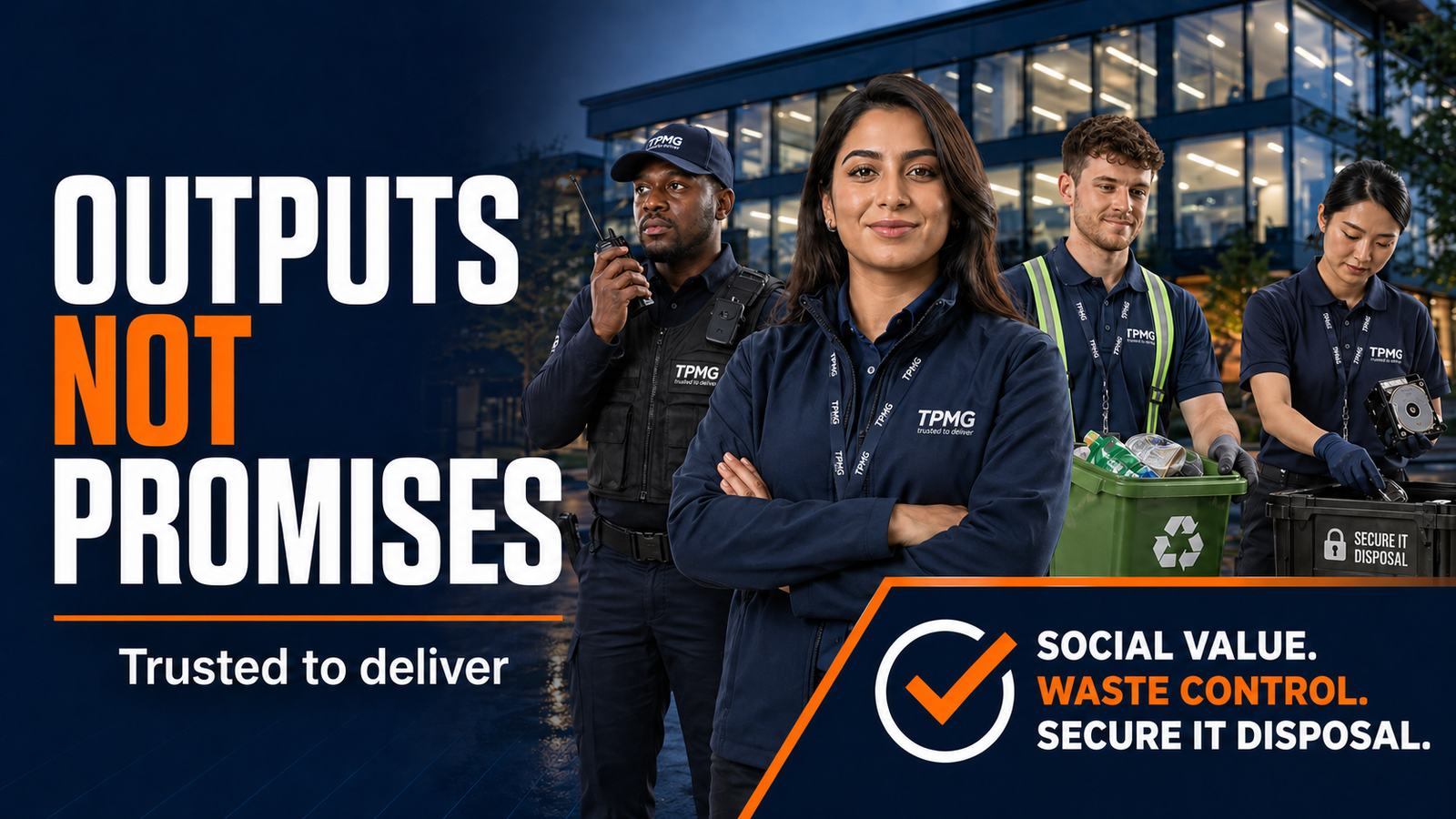
A modern FM contract should not rely on broad promises about ESG, recycling or community impact. Buyers need something much more useful than that. They need outputs, controls, records and reporting that stand up to contract reviews, procurement scrutiny, compliance checks and operational reality. That matters even more now because the direction of travel is clear. In central government procurement, the updated Social Value Model requires suppliers to set out specific, measurable and time-bound commitments in a method statement and project plan, with reporting against selected outcomes and metrics. From 1 October 2025, use of the updated model is mandatory for in-scope central government procurements. So the right question for buyers is no longer, “Do you offer social value and sustainable waste services?” It is, “How will this be measured, evidenced and managed through the life of the contract?” 1. Social value should be written as contract delivery, not brochure language Good social value in FM should look like part of the operating model, not a side promise. The Social Value Model is built around defined outcomes, award criteria and standard reporting metrics. It explicitly expects measurable commitments and, for relevant outcomes, asks suppliers to provide a baseline for the number of people who will work on the contract. It also includes metrics such as employment opportunities created, community engagement activities, and people from under-represented groups employed under the contract. In practice, that means buyers should expect numbers like these to be contract-specific and reviewable:new roles created or retained, apprenticeships started, job starts from under-represented groups, outreach or community engagement activities delivered, volunteering hours, and progress against agreed milestones. A supplier should also be able to show who owns delivery, how performance is monitored, and what happens if the commitment slips. The weak version is: “We support local communities.”The strong version is: “We will create X roles, deliver Y apprenticeships, run Z engagement activities, report quarterly, and track outcomes against named metrics and escalation points.” 2. Waste control should be visible, documented and hierarchy-led Waste control in a modern FM contract should also be measurable. In England, workplace recycling rules changed on 31 March 2025. All workplaces must separate dry recyclables, food waste and non-recyclable waste before collection, with micro-firms exempt until 31 March 2027. That means waste service design can no longer be vague. Segregation, signage, collection routines and contamination control now need to be built into daily operations. There is also still the basic duty of care. For each load of non-hazardous waste removed from site, a business needs a waste transfer note or equivalent document, both parties must sign it, and both sides must keep a copy for two years. Season tickets can be used for repeated transfers, but they still require a schedule showing dates, times, quantities and sites. And above all that sits the waste hierarchy. DEFRA’s guidance says businesses and public bodies that generate, handle or treat waste should apply the hierarchy, which ranks options by environmental impact. So in contract terms, waste control should usually be measured through:segregation compliance, contamination levels, tonnage by stream, recycling rate, food waste capture, collection frequency, missed collections, documentation completeness, and cost or carbon improvements linked to changed routines. Those are the kinds of measures that tell a buyer whether the contract is genuinely under control or just being emptied on schedule. 3. Secure IT disposal should be treated as a control service, not a bin movement This is where many contracts still fall behind. Secure IT disposal is not just a recycling issue. It is a data-security, custody and compliance issue that happens to end with reuse, destruction or WEEE recycling. The NCSC says any device that might contain electronic storage media should be sanitised, and that simply pressing delete is not enough. It also says organisations should record the lifecycle of storage media, have a reuse and disposals policy, and understand sanitisation requirements before the device leaves organisational control. Where the risk is higher, physical destruction is required, with the media reduced to particles of 6mm or less, and that particle size should be verified. The ICO adds a very practical layer to that. It expects organisations to use and document secure disposal methods, store devices awaiting destruction securely, keep a log of those devices and their location, and consider access logs for those areas. It also makes clear that if electronic records are not destroyed securely, they may be recoverable, which can create UK GDPR risk. And once electrical equipment becomes waste, WEEE rules matter too. GOV.UK says WEEE is regulated to reduce the amount incinerated or sent to landfill and to encourage recovery, reuse and recycling. The underlying UK legislation was amended in 2025. So a buyer-ready FM contract should not describe secure IT disposal as “collection and recycling.” It should describe:asset logging, chain of custody, secure storage, erasure route, destruction route, reuse decisions, WEEE-compliant downstream handling, and certificates or reports showing what happened to each asset batch. 4. What good looks like when these three areas are combined The best FM contracts treat social value, waste control and secure IT disposal as part of one disciplined contract-management model. That means:a clear baseline at mobilisation, named owners, agreed KPIs, monthly or quarterly review points, corrective actions, and contract evidence that is easy for the client to retrieve. It also means the supplier can explain the logic behind the numbers, not just send a dashboard. A modern buyer should be able to ask:What exactly are we measuring?Who owns each metric?How often is it reported?What evidence supports it?What happens if it drops behind target? If the supplier cannot answer those questions cleanly, the service is probably still too reactive. That is not modern FM. That is just activity without enough control. 5. The TPMG view At TPMG FM, this is the standard buyers should expect. Social value should be measurable.Waste control should be documented.Secure IT disposal should be controlled end-to-end. Because once a contract is live, confidence does not come from good intentions. It comes